Four different clues
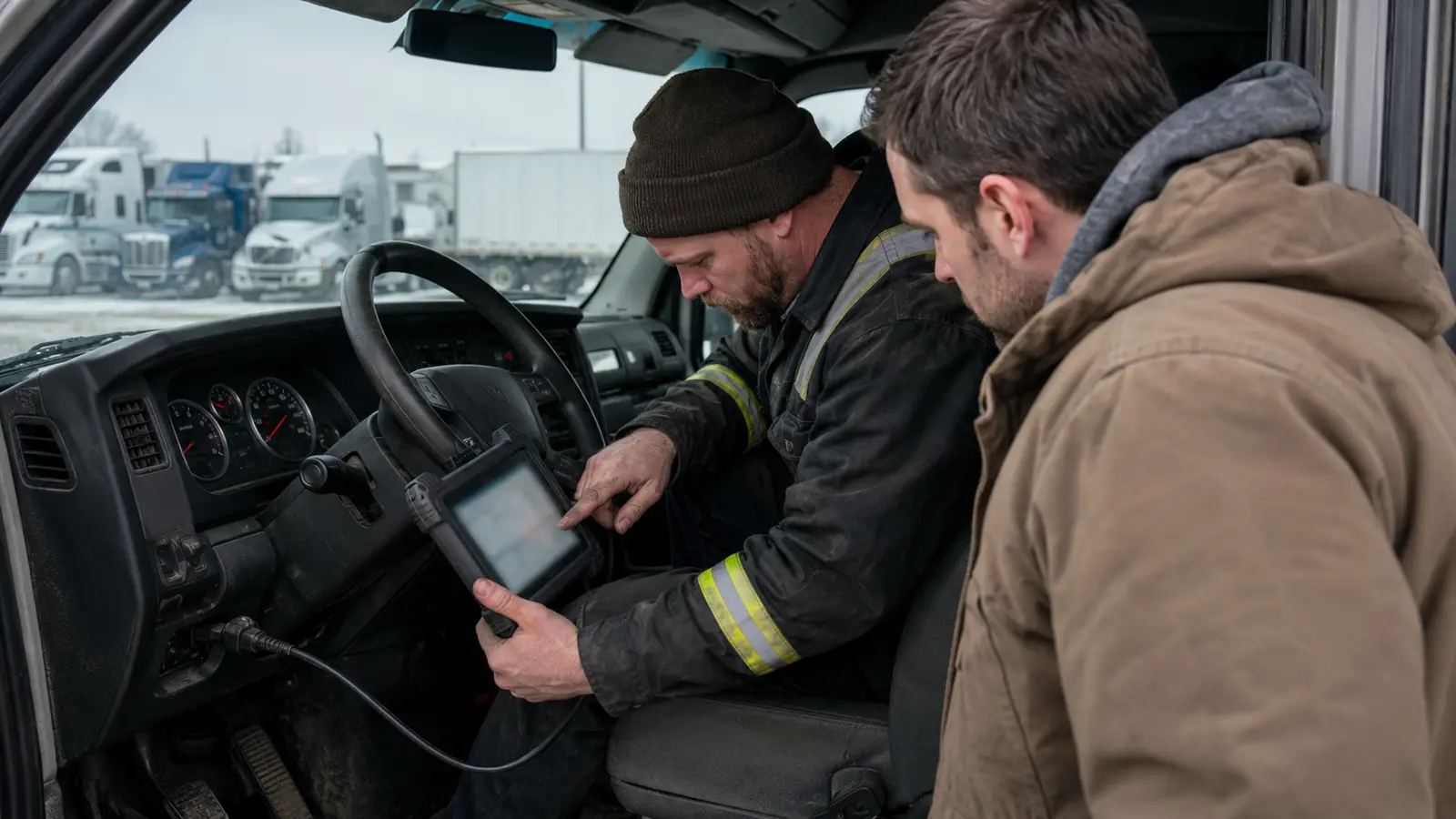
Odometer kilometres record road distance. Total engine hours record time running. Idle hours, where available, identify a portion of low- or no-road-speed operation. Duty-cycle records and service history explain what the truck was doing during that time.
Average operating speed
Dividing kilometres by total engine hours gives a simple lifetime average operating speed. For example, 600,000 km divided by 12,000 hours is 50 km/h. That is a clue—not a pass/fail threshold—because routes, idling, PTO work and data replacement can change the result.
Highway and vocational use
Long-haul operation can accumulate kilometres quickly at steady speed. Local, vocational, yard, PTO or winter-idle duty may accumulate more hours per kilometre. Low kilometres therefore do not automatically mean low mechanical usage.
Condition still requires inspection
Neither hours nor kilometres determines condition alone. Compare all readings with maintenance intervals, ECM reports where available, interior and chassis wear, major repairs and a qualified inspection.
Reconcile the timeline
Compare dated service entries, ECM reports and any component replacement with the current odometer and hour readings. A replaced cluster or control module can create apparent inconsistencies that require documentation.
Verify the individual truck
Build information, component tags, service records, diagnostics and a qualified inspection take priority over general family-level guidance.
Sources & Technical References
Primary manufacturer and government resources for continuing configuration-specific research.
Cummins electronic control unitsDetroit DiagnosticLink capabilities