2018 reveal → pre-series work Verified
Prototype and customer development
The 2018 announcement describes development vehicles. Its battery and performance figures must not be used as production-truck specifications.
View dated specifications →
THE FREIGHTLINER HISTORICAL REFERENCE
Keep prototype and production electric specifications separate, with distinct single- and tandem-drive references.
01 / IDENTIFY THE TRUCK
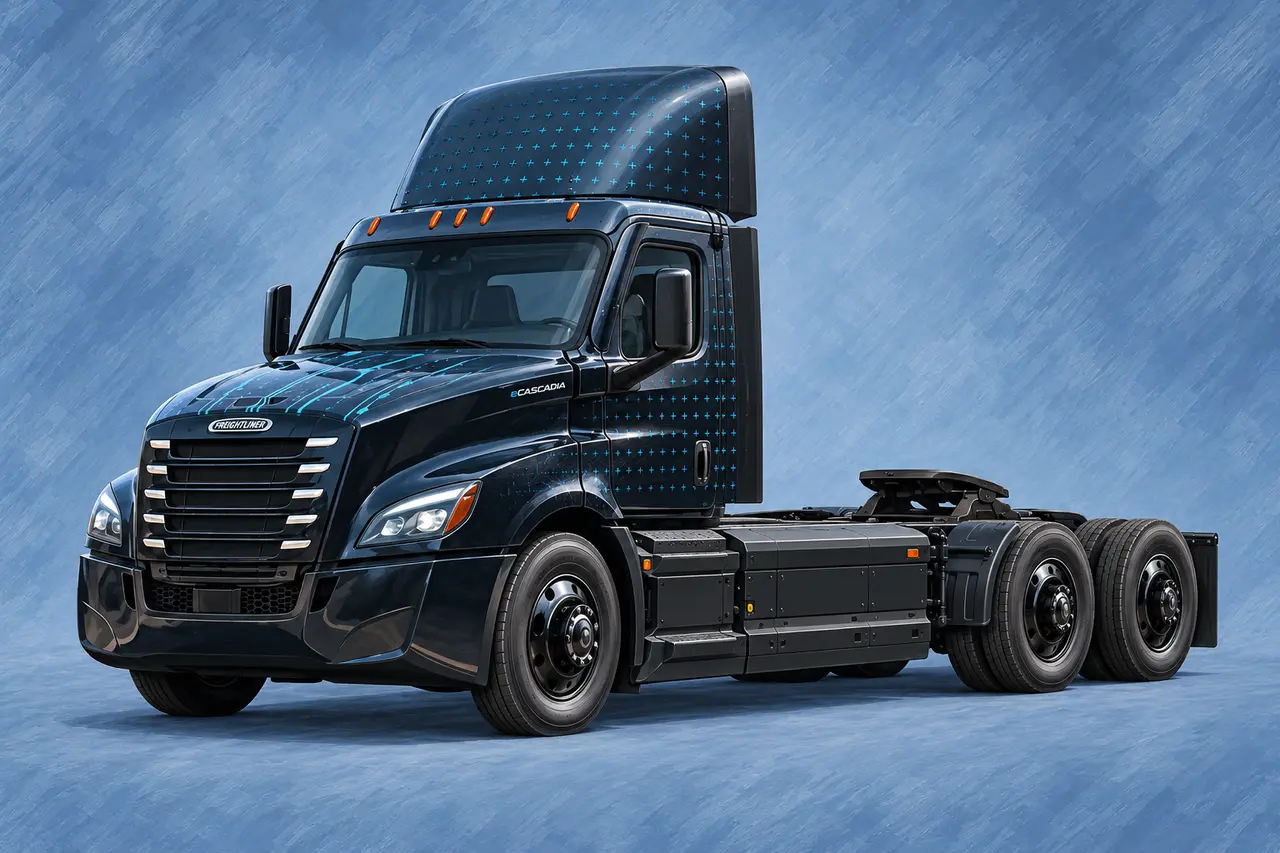
eCascadia is the battery-electric highway tractor family. Prototype ratings, customer trials and production specifications are separate evidence sets.
Series-production chronology begins in 2022. The separately labelled 2018 reference describes prototypes, not a production model year.
Select a year, or explore the full family chronology below.
The 2018 announcement describes development vehicles. Its battery and performance figures must not be used as production-truck specifications.
View dated specifications →The first heavy-duty eCascadias entered customer trials with Penske Truck Leasing and NFI Industries in 2019. Field testing remains separate from the 2022 series-production milestone.
The contemporaneous annual report names the customers and achieved trial phase. It does not convert field-test vehicles into a market launch, retail availability or an exact model-year boundary.
View dated specifications →This filing is a precise equipment-qualified campaign checkpoint. It creates no series-production launch claim, complete availability range, family endpoint or generation boundary.
DTNA's Part 573 filing names one eCascadia MY2020–MY2025 campaign range and supplies a model-level manufacturing interval. MY2020–MY2021 are retained only as regulator campaign coding and do not revise the separate 2022 series-production chronology.
View dated specifications →DTNA separated the series-production truck from the earlier customer-test fleet and published drive, battery, range and weight choices. The release verifies the launch specification, not the exact first build day or first model year.
A dated DTNA world-premiere release for the series-production configuration. Its within-2022 production and delivery statements remained prospective on May 9.
View dated specifications →The November release converts the May 2022 production plan into bounded achieved evidence: Sysco received a series-produced Class 8 eCascadia, while DTNA described production units moving from the line to customers.
A dated DTNA release identifies one series-produced eCascadia received by Sysco and describes production trucks rolling off the Portland line. The company-specific “first” is not generalized to the first production truck or first industry delivery.
View dated specifications →Production and the current specification page establish a separate electric reference. Single- and tandem-drive ratings are kept apart in the selectable profiles below.
View dated specifications →The two dated manufacturer records deepen campaign and configuration provenance without splitting one range into invented annual production tables or reconciling unexplained population differences.
DTNA’s July 2023 Part 573 filing and November 2023 revised service campaign identify the same bounded eCascadia e-axle population while documenting distinct filing-time defect chronology and later 4×2/6×4 repair conditions.
View dated specifications →The same DTNA release distinguishes the customer-test phase from 2022 series production and reports more than six million real-world customer miles across more than 50 U.S. fleets by April 2024.
This official retrospective supplies an achieved usage checkpoint and confirms series-production chronology. Its 2019 customer-test wording is not substituted for the separately sourced June 2018 prototype reveal.
View dated specifications →This exact row deepens equipment-qualified regulator provenance without establishing continuous availability, a production quantity, universal equipment configuration, a first/final model year, a production endpoint or dimensional geometry.
NHTSA campaign 25V603000 returns the named eCascadia MY2026 row with condition, consequence, remedy and combined-population fields.
View dated specifications →DTNA presented the series-production configuration and said production and customer deliveries would begin in 2022. The release does not supply an exact first build day or first model year.
Sysco received its first series-produced eCascadia and DTNA described units rolling off the production line. This is an achieved customer-delivery checkpoint, not the first eCascadia build or first model year.
02 / CHOOSE THE APPLICABLE REFERENCE
Start with the model configuration, then choose a publication and explore its documented equipment.
Selecting equipment records your research choice. It does not calculate dimensions, establish an available combination or rate a truck.
Current series-production reference · September 2026. Single and tandem specifications remain separate. The two advertised power ratings are discrete choices, not a continuous order range. Published maximum GCW is not trailer payload; individual build and operating limits apply.
Freightliner · eCascadia specifications, reviewed September 2026 ↗
Validated dimension illustration scope: Current series-production 116-inch-BBC tandem-drive day-cab orientation. The dedicated side illustration matches the documented cab and tandem architecture; only A has a factory-published numerical value. Use the cited dimension table for the published values; unverified letters remain measurement prompts. Read the dimension evidence.
DIMENSION GUIDE / A–H
Select a measurement to highlight its endpoints and see what the chosen publication confirms.
Freightliner eCascadia · eCascadia · tandem drive · Current series-production reference · September 2026 · 1 published / 7 to verify
Front-view illustration pending. Width and height definitions remain available in the cards below.
Front bumper to the back of the driving cab. Excludes an additional sleeper; it is not overall tractor length.
Published for this reference; confirm the individual build.
Current series-production 116-inch-BBC tandem-drive day-cab orientation. The dedicated side illustration matches the documented cab and tandem architecture; only A has a factory-published numerical value. The artwork is schematic and not to scale; published values come from the cited factory diagram, never from image pixels.
Selected reference: Freightliner · eCascadia specifications, reviewed September 2026. Published values remain tied to this edition.
View the complete dimension table ↓03 / PERIOD-APPROPRIATE EVIDENCE
Each table retains its printed edition, market and configuration. A publication snapshot is not a specification for every year in the family.
One pre-production eCascadia in the Freightliner Electric Innovation Fleet · United States · Ontario to Los Angeles, California
The release documents a physical pre-production eCascadia pulling a full-sized racecar hauler. It separately reports the 20-truck Electric Innovation Fleet and Penske accumulated-use total; neither is series-production volume or a model-year boundary.
| Specification | Documented value / configuration |
|---|---|
| Physical operation | Pre-production eCascadia pulled a Team Penske racecar hauler from Ontario, California to the Los Angeles Memorial Coliseum |
| Development fleet | 20 battery-electric trucks: 10 eCascadia day-cab tractors and 10 eM2 box trucks |
| Accumulated use reported | More than 480,000 miles across the Penske-operated development trucks |
| Series-production statement | Final series production was still forecast for later in 2022 |
| Evidence limit | The event vehicle, mixed-fleet count and accumulated miles do not establish a series-production quantity, exact model year, first production build, universal configuration or endpoint |
Penske customer-test eCascadia used for a racecar-hauler trip · United States · Portland, Oregon
The dated release documents one eCascadia hauling a Team Penske racecar from DTNA headquarters to Portland International Raceway after charging at Electric Island. It describes the Penske programme as customer testing since 2020 and does not identify this truck as a series-production customer delivery.
| Specification | Documented value / configuration |
|---|---|
| Physical operation | eCascadia hauled the No. 3 Team Penske racecar from DTNA headquarters to Portland International Raceway |
| Charging checkpoint | Truck charged at DTNA and Portland General Electric’s Electric Island site |
| Programme scope | Penske had tested eCascadias with customers in logistics operations since 2020 |
| Published configuration context | The release describes multiple battery and drive-axle options and a configuration-dependent typical range of 230 miles |
| Evidence limit | One programme haul and configuration-dependent range do not establish an exact model year, series-production delivery, universal range, production total, generation boundary or endpoint |
Letter of intent for future eCascadia deployments; not achieved deliveries · United States · proposed Sysco deployment
The joint release records an intention to deploy up to nearly 800 eCascadia tractors by 2026 and an expected first Riverside delivery later in 2022. Both quantities and timing were prospective on publication day.
| Specification | Documented value / configuration |
|---|---|
| Agreement type | Letter of Intent |
| Proposed quantity | Up to nearly 800 battery-electric eCascadia Class 8 tractors |
| Proposed horizon | Serving Sysco customers by 2026 |
| First-delivery statement | Expected at Sysco Riverside later in 2022 |
| Evidence limit | Intent, proposed quantity and expected timing do not establish achieved deliveries, production volume, an exact model year, continuous availability or an endpoint |
First heavy-duty eCascadia customer trials during 2019 · United States · customer field-test context
The report contemporaneously confirms that the first heavy-duty eCascadias started customer trials in 2019 and names Penske Truck Leasing and NFI Industries. This is pre-series field testing, not market launch, series production, retail availability or an exact first model year.
| Specification | Documented value / configuration |
|---|---|
| Achieved trial start | 2019 · first heavy-duty Freightliner eCascadia customer trials started |
| Named customers | Penske Truck Leasing and NFI Industries |
| Activity class | Customer field testing feeding ongoing electric-product development |
| Earlier programme context | The same customers had already started testing the medium-duty all-electric Freightliner eM2 in 2018 |
| Later milestone kept separate | 2022 eCascadia series production remains a distinct achieved event |
| Boundary limit | No market launch, retail sale, exact first build, first model year, trial-fleet count, production quantity, configuration range or endpoint inferred |
One filed eCascadia MY2020–MY2025 campaign row; not six separately dated production rows · United States · manufacturer Part 573 safety-recall filing
DTNA identifies certain eCascadia vehicles equipped with an Electric Vehicle Power Distribution Module. The filing says its recall population runs from start of production through January 2025, but that wording is campaign-population language: it is not used here to move the controlled 2022 series-production chronology backward.
| Specification | Documented value / configuration |
|---|---|
| Filed vehicle identity | Freightliner eCascadia · MY2020–MY2025 · NHTSA 25V-046 / DTNA F1017 |
| Model-level manufacturing interval | August 11, 2020–January 13, 2025 · applies to the complete filed eCascadia campaign row, not separately to every model year and not to the whole family |
| Equipment / condition | Electric Vehicle Power Distribution Module connector plate assembly may pull away from and eventually separate from the housing, disconnecting one or more circuits |
| Published risk / warning | Worst case is loss of motive power without advance warning; some circumstances may first produce instrument-cluster messages and telltales |
| Manufacturer remedy | Inspect the EVDM; qualifying modules receive reinforcement or replacement free of charge |
| Production control | Enhanced supplier retention process began October 7, 2024; DTNA says the updated EVDM was fully implemented in production in mid-January 2025 |
| Complete campaign population | 810 vehicles across the combined eCascadia and eM2 filing · not an eCascadia, family or model-year production count |
| Programme boundary | The eM2 MY2022–MY2026 row is excluded because it is not the M2 112 dossier and this programme has no separate eM2 family page |
| Chronology limit | MY2020 and MY2021 remain labelled regulator campaign checkpoints outside the series-production chronology. This filing does not establish an exact first production model year, first customer build, continuous availability, generation cutover, family endpoint or dimensional geometry. |
Series-production 116-inch day-cab launch configuration · North America
Launch specification only. Range varies by drive and battery configuration. The release announced production and deliveries beginning in 2022 but did not identify an exact first build day or first model year.
| Specification | Documented value / configuration |
|---|---|
| Cab / architecture | 116-in BBC day cab; single- or tandem-drive eAxle |
| Published power range | 320–470 hp |
| Battery choices in release | 291 kWh single-drive; 438 kWh single- or tandem-drive |
| Typical range by configuration | 155 mi single-drive standard; 230 mi single-drive long-range; 220 mi tandem-drive |
| Published maximum GCW | 82,000 lb |
| Charging statement | 80% in approximately 90 minutes; configuration and charger dependent |
| Production / delivery statement | Beginning in 2022 — prospective at the May 9 world premiere |
| Chronology limit | No exact first build day, first model year or continuous edition range established |
Publication snapshot · North America
One named customer delivery and series-production status. Published range and powertrain statements repeat the launch family, not a VIN-specific build sheet or a new generation.
| Specification | Documented value / configuration |
|---|---|
| Customer milestone | Sysco received its first series-produced eCascadia |
| Vehicle class / architecture | Battery-electric Class 8 tractor |
| Production statement | eCascadia described as rolling off the production line and into customers’ hands |
| Prototype testing context | More than 1.5 million customer-fleet miles accumulated since 2018 |
| Published range choices | 155, 220 or 230 mi depending on configuration |
| Chronology limit | Not the first completed eCascadia, first model year, exact first-build day, complete order range or a universal customer-delivery date |
Electric Freightliner Cascadia manufacturing location · North America · Portland, Oregon plant
DTNA explicitly states that its Portland plant manufactures electric Freightliner Cascadia trucks. This is a dated achieved-manufacturing and location checkpoint, not a model-specific production count, start date, exact configuration or endpoint.
| Specification | Documented value / configuration |
|---|---|
| Factory statement | DTNA Portland plant manufactures electric Freightliner Cascadia trucks |
| Plant context | The same plant also manufactures Western Star X-Series models |
| Oregon context | DTNA reported more than 3,000 employees in Oregon and investment in electric and advanced-diesel truck production |
| Evidence limit | No eCascadia production count, exact build date, first or final model year, configuration mix, continuous range or endpoint is established |
Three Class 8 eCascadia tractors added to TITAN Freight Systems operations · United States · Portland metropolitan area
DTNA documents three battery-electric eCascadia trucks added to TITAN Freight Systems for Portland-area deliveries, with six depot chargers installed. The record is a bounded customer-deployment checkpoint, not a production count or statewide availability boundary.
| Specification | Documented value / configuration |
|---|---|
| Physical fleet | Three battery-electric Freightliner eCascadia Class 8 trucks added to TITAN Freight Systems |
| Operating scope | Deliveries to businesses throughout the Portland metropolitan area |
| Charging context | Six Detroit eFill commercial charging stations installed at the TITAN depot |
| Customer distinction | DTNA identifies TITAN as its first customer in Oregon |
| Evidence limit | Three customer trucks do not establish total production, an exact model year, first series build, statewide availability, continuous range, universal configuration or endpoint |
One autonomous technology demonstrator based on a production eCascadia day cab · United States · research and advanced engineering
Daimler Truck identifies a research demonstrator combining a production eCascadia base with Torc software and prototype Level 4 sensor, compute and cooling hardware. Its architecture is development evidence only and is not a customer-production configuration.
| Specification | Documented value / configuration |
|---|---|
| Vehicle basis | Production battery-electric eCascadia day-cab platform used as the demonstrator base |
| Development system | Torc autonomous-driving software with prototype Level 4 sensor and compute technology |
| Prototype packaging | Compute stack between the seats with a prototype air-cooling concept; sensor bar integrates cameras, lidar and radar |
| Electrical support | Four additional 12-volt batteries for the autonomous system |
| Evidence limit | A research demonstrator does not establish customer availability, series equipment, achieved Level 4 operation, an exact model year, a new production generation or an endpoint |
One eCascadia deployed in DTNA inbound logistics and operated by Load One · United States · Livonia–Redford, Michigan shuttle operation
DTNA documents one eCascadia entering its Michigan shuttle programme to move components between the Detroit Logistics Center and Redford production facility. The published 220-mile typical range applies only to the equipped vehicle.
| Specification | Documented value / configuration |
|---|---|
| Physical operation | One eCascadia integrated into DTNA inbound logistics and operated by Load One |
| Route | Detroit Logistics Center in Livonia to the Redford production facility |
| Published equipped range | Typical range of 220 miles for this configuration |
| Charging point | Detroit Logistics Center |
| Evidence limit | One shuttle vehicle and its equipped range do not establish universal specifications, production volume, exact model year, continuous availability, first delivery or endpoint |
Twenty battery-electric Class 8 tractors delivered to Reyes Coca-Cola Bottling · United States · Downey, California customer fleet
DTNA documents 20 physical eCascadia tractors delivered to Reyes Coca-Cola Bottling for Southern California distribution. The count belongs to this customer deployment only; projected annual diesel reduction and published charging/range figures remain conditional or configuration-dependent.
| Specification | Documented value / configuration |
|---|---|
| Delivered fleet | 20 battery-electric Freightliner eCascadia Class 8 tractors |
| Operating base | Reyes Coca-Cola Bottling · Downey, California |
| Depot infrastructure | 20 Detroit eFill commercial charging stations |
| Published range envelope | 155, 220 or 230 miles depending on battery and drive-axle configuration |
| Evidence limit | A 20-tractor customer delivery does not establish total production, an exact model year, universal equipment, continuous availability, generation boundary or endpoint; projected annual fuel reduction is not measured fleet performance |
First of two Portland-built eCascadias delivered to Transportes Esteban · Mexico · Santiago Tianguistenco plant logistics
DTNA Mexico identifies the first customer eCascadia entering day-to-day plant logistics in Mexico and a matching 120 kW charging installation. This regional deployment is not evidence of U.S. or Canadian chronology and does not establish a North American model-year boundary.
| Specification | Documented value / configuration |
|---|---|
| Physical vehicle | First of two Portland-built eCascadias delivered to Transportes Esteban |
| Operation | Daily logistics at Daimler Truck Mexico’s Santiago truck manufacturing plant |
| Regional distinction | DTNA identifies it as the first all-electric Freightliner unit operating in Mexico |
| Charging installation | Detroit eFill charger rated up to 120 kW; published 80% charge time of 220 minutes |
| Evidence limit | One regional customer truck does not establish an exact model year, broader Mexican availability, U.S./Canadian chronology, total production, continuous range, universal specification or endpoint |
Two Portland-built eCascadia tractors delivered to Goodwill Industries of New Mexico · United States · Albuquerque, New Mexico customer fleet
DTNA documents two eCascadia tractors delivered to Goodwill Industries of New Mexico and calls them the first eCascadias operating in the state. The record also reports the then-current programme total as more than 50 North American fleets and more than four million customer miles.
| Specification | Documented value / configuration |
|---|---|
| Delivered fleet | Two battery-electric Freightliner eCascadia tractors manufactured in Portland |
| Operating base | Goodwill Industries of New Mexico · Albuquerque |
| Regional distinction | First eCascadias operating in New Mexico |
| Programme checkpoint | More than 50 North American fleets and more than 4 million real-world electric miles since 2022 production start |
| Evidence limit | Two customer tractors and an aggregated fleet-mile statement do not establish total production, an exact model year, universal configuration, continuous availability, generation boundary or endpoint |
Twenty delivered tractors plus nine later scheduled for Reyes Beverage Group · United States · California customer fleet
DTNA separates 20 already delivered eCascadias at two California warehouses from nine vehicles scheduled for a later delivery. The table preserves that achieved-versus-forecast boundary and limits the published 220-mile range to the equipped fleet.
| Specification | Documented value / configuration |
|---|---|
| Achieved delivery | 20 eCascadia Class 8 tractors deployed at East Bay and Huntington Beach warehouses |
| Later forecast | Nine additional vehicles scheduled for the San Bernardino warehouse later in 2024 |
| Equipped range | Typical 220-mile range for the published Reyes Beverage configurations |
| Broader product envelope | 155–230 miles depending on battery and drive-axle configuration |
| Evidence limit | The scheduled nine are not counted as delivered; the customer deployment does not establish total production, an exact model year, universal range, continuous availability, generation boundary or endpoint |
DTNA internal logistics; achieved regional starts kept separate from future expansion plans · United States Pacific Northwest · Mexico plant operation
The initial release describes four electric vehicles entering Pacific Northwest inbound logistics. DTNA’s later factory release dates the eCascadia integration there to December 2023 and the Santiago, Mexico plant deployment to January 2024. Other regional expansion remained a plan.
| Specification | Documented value / configuration |
|---|---|
| Pacific Northwest initial deployment | Four electric vehicles assigned to supplier pickups and delivery to DTNA’s Portland consolidation center |
| Pacific Northwest achieved start | December 2023, as stated in DTNA’s April 2024 follow-up |
| Mexico achieved start | January 2024 at Daimler Truck Mexico’s Santiago truck manufacturing plant |
| Production context | DTNA identifies Portland as the plant where eCascadia and eM2 are built |
| Evidence limit | Internal logistics starts are not production totals, model-year boundaries, universal configurations, continuous regional availability or proof that later expansion plans occurred |
One J.B. Hunt eCascadia on DTNA’s first all-electric aftermarket-parts route · United States · Phoenix, Arizona
DTNA documents a physical eCascadia operating a dedicated Phoenix-area aftermarket-parts route. The roughly 100-mile daily route and installed charger apply to this operation; future expansion remained under analysis.
| Specification | Documented value / configuration |
|---|---|
| Physical operation | One eCascadia in J.B. Hunt’s fleet delivering DTNA aftermarket parts from the Phoenix distribution center to dealers |
| Route scope | Dedicated route covering approximately 100 miles daily |
| Network milestone | First all-electric route in DTNA’s aftermarket-parts distribution network |
| Charging checkpoint | Detroit eFill charger installed at DTNA’s Phoenix parts distribution center |
| Evidence limit | One operating route does not establish a production count, exact model year, universal duty cycle, continuous availability, generation boundary or endpoint |
Filed MY2023–MY2024 eCascadia electric campaign range · United States · manufacturer Part 573 safety-defect filing
DTNA limits the filed population to eCascadia vehicles built with e-axles whose planetary gear sets were produced during the suspect supplier period.
| Specification | Documented value / configuration |
|---|---|
| Filed campaign identity | Freightliner eCascadia · MY2023–MY2024 · filing powertrain label “HYBRID ELECTRIC” · NHTSA 23V-467 / DTNA FL979 |
| Model-level manufacturing interval | January 19–April 13, 2023 · scoped to the complete filed MY2023–MY2024 eCascadia row, not a family production run |
| Suspect-population basis | One or more e-axles, depending on vehicle configuration, may contain planetary gear sets produced during a supplier welding-process deviation; vehicles outside the population do not have gear sets from the suspect period |
| Defect / consequence | An insufficient weld can fracture under high torque and/or road vibration, separating the e-motor from the final drive; the filing says this can cause an undetectable sudden loss of motive power without restart capability and increase crash risk |
| Warning in the filing | None reported. The filing chronology says an instrument cluster did not display a telltale or diagnostic trouble code in one investigated loss-of-forward-movement event. |
| Filed population | 82 vehicles; estimated defect rate 100% · complete U.S. filing field, not an annual production count |
| Supplier production control | The supplier adjusted its welding process; DTNA reported that parts produced after March 3, 2023 were sufficiently welded |
| Evidence limit | One MY2023–MY2024 campaign range is not split into annual production tables. The filing does not establish an exact first/final model year, continuous availability, family endpoint, configuration mix, production volume, generation boundary, successor relationship or A–H dimensional geometry. |
Specific MY2023–MY2024 eCascadia vehicles manufactured January 19–April 13, 2023 · United States and Canada · manufacturer recall-service campaign
The bulletin documents six FL979 condition codes across single-rear-axle 4×2 and tandem 6×4 e-axle configurations; it is repair/configuration evidence, not a complete production roster.
| Specification | Documented value / configuration |
|---|---|
| Campaign configuration groups | FL979A: 4×2 single rear e-axle without DCDL; FL979B–D: first rear e-axle in 6×4 configurations; FL979E–F: second rear e-axle in 6×4 configurations. DCDL and non-DCDL conditions remain distinct. |
| Published remedy | Replace the affected e-axle(s). The bulletin lists 11.4 labor hours for one rear electric axle and 9.9 hours for the first or second rear electric axle, plus campaign-specific parts. |
| Bulletin campaign count | Approximately 95 vehicles · retained as the later bulletin’s own figure. It is not merged with or substituted for the Part 573 filing’s 82-vehicle U.S. population because the documents do not explain the difference. |
| Revised owner-notice ranges | One notice states certain MY2024 vehicles manufactured January 31–April 12, 2023; another states MY2023–MY2024 manufactured January 19–April 13, 2023. The broader campaign header/range remains controlling here; the narrower notice is preserved as a condition-specific subrange, not a chronology contradiction. |
| Evidence limit | Condition codes and service labor do not quantify each production configuration, define a new generation, prove universal axle fitment, establish current repair status or supply exact A–H dimensional geometry. |
Factory retrospective and achieved fleet-use checkpoint · United States
DTNA retrospectively separated the 2019 customer-test-vehicle phase from 2022 series production and reported accumulated U.S. fleet experience by the release date. This does not replace the separately documented June 2018 prototype reveal.
| Specification | Documented value / configuration |
|---|---|
| Customer-test phase | 2019 · eCascadia identified retrospectively as a customer test vehicle |
| Series-production milestone | 2022 · eCascadia entered series production |
| Real-world customer use | More than 6 million miles accumulated by April 17, 2024 |
| Fleet scope | More than 50 fleets in the United States |
| Event distinction | 2018 prototype announcement, 2019 customer-test phase and 2022 series production remain separate events |
| Boundary limit | No exact first build, first model year, first customer delivery, production volume, battery edition or configuration-specific range inferred |
Exact NHTSA eCascadia MY2026 row within the complete 25V603000 response · United States · NHTSA exact campaign record
NHTSA lists eCascadia MY2026 within this equipment-qualified safety campaign. The literal eCascadia label is not expanded to an unlisted configuration or treated as a generation boundary.
| Specification | Documented value / configuration |
|---|---|
| Exact campaign identity | eCascadia · MY2026 · NHTSA 25V603000 / DTNA D25R2 |
| Equipment / condition | The tie-rod castle nut and cotter pin may be improperly installed, allowing the tie rod to separate and causing loss of steering control |
| Published consequence | Loss of steering control increases crash risk |
| Manufacturer remedy | Inspect the tie-rod castle nut and cotter pin and replace the tie-rod assembly as necessary, free of charge · owner letters mailed November 10, 2025 |
| Complete campaign population | 343 vehicles across the complete 23-row response · not a family or model-year production count |
| Response roster boundary | Nine literal Freightliner rows are retained: Business Class M2 MY2024–MY2026, Cascadia MY2025–MY2026, eCascadia MY2026, 114SD MY2025–MY2026 and 108SD MY2026. Fourteen FCCC, Western Star and Thomas Built Buses rows remain outside this programme. |
| Manufacturing interval | The API response provides no campaign-wide manufacturing interval; applicability is limited to its literal model/model-year rows. |
| Evidence limit | Campaign applicability establishes neither universal tie-rod or steering configuration, a family production quantity, continuous availability, exact first/final model year, build endpoint, generation boundary, successor relationship nor A–H dimensional geometry. |
04 / DIMENSIONS
eCascadia · tandem drive · Current series-production reference · September 2026
| Measurement | Reference value | Scope / how to verify |
|---|---|---|
| Bumper to back of cab (BBC) | 116 in2,946 mm | Published in the selected manufacturer reference.Freightliner · eCascadia specifications, reviewed September 2026 ↗ |
| Measurement | Reference value | Scope / how to verify |
|---|---|---|
| Wheelbase | Not verified | Build record / measurement required. |
| Overall tractor length | Not verified | Build record / measurement required. |
| Overall height | Not verified | Build record / measurement required. |
| Cab / body exterior width | Not verified | Build record / measurement required. |
| Width across mirrors | Not verified | Build record / measurement required. |
| Fifth-wheel height | Not verified | Build record / measurement required. |
| Bumper to front axle (BA) | Not verified | Build record / measurement required. |
Measure fixed exterior width and mirror width separately, plus overall length, the highest accessory, fifth-wheel height and actual transport weight. Interior bunk width is not exterior width.
05 / POWERTRAIN & CHASSIS
Detroit eAxle electric propulsion. Tandem drive · 438 kWh usable battery. Read engine, gearbox and axle ratings together.
| Measurement | Reference value | Scope / how to verify |
|---|---|---|
| Published maximum GCW | 82,000 lb37,195 kg | Published in the selected manufacturer reference.Freightliner · eCascadia specifications, reviewed September 2026 ↗ |
| Advertised power choices | 425 or 470 hp317 or 350 kW | Published in the selected manufacturer reference.Freightliner · eCascadia specifications, reviewed September 2026 ↗ |
Read the installed unit’s identification plate and build record.
Single and tandem specifications remain separate. The two advertised power ratings are discrete choices, not a continuous order range. Published maximum GCW is not trailer payload; individual build and operating limits apply.
06 / IDENTIFICATION & BUYER RESEARCH
Publication dates and launch milestones do not establish continuous model-year ranges. Match the VIN, production date and equipment era.
Confirm series-production build, usable battery configuration, eAxle arrangement, charging equipment and service records. Do not substitute prototype battery claims for the installed production pack.
07 / TRANSPORT & TRAILER RESEARCH
A battery-electric tractor needs a route and charging assessment as well as axle and coupling checks. Payload, weather, auxiliaries, regeneration and depot dwell time affect operating suitability; a published typical range cannot guarantee a route.
Start with deck length, load placement, axle distribution and cab-to-trailer clearance.
Read the guide HIGHWAYTRAILERS.CACompare deck height, gooseneck geometry and the loaded combination’s height.
Read the guide HIGHWAYTRAILERS.CACheck neck compatibility, fifth-wheel loading, wet-kit requirements and the complete axle layout.
Read the guide HIGHWAYTRAILERS.CAReview the tractor, coupling, trailer, tyres and load as one combination.
Read the guideConfirm build-specific combination, axle, tyre and coupling ratings, kingpin and service connections, clearance and actual axle weights. GVW is the loaded truck; GCW is the loaded combination. Neither is trailer payload.
Give the carrier measured length, exterior and mirror widths, height, ground clearance and transport weight. Assess deck access, breakover, loaded height and securement together.
Deck height & loaded height ↗The model badge, artwork and catalogue option selectors cannot rate an individual combination. Obtain the actual build limits and scale weights.
09 / SOURCES & OPEN QUESTIONS
Reviewed September 14, 2026. Manufacturer figures remain tied to their stated reference; converted equivalents are rounded; original source units are retained. Application and inspection notes are editorial guidance.
Verified: primary evidence for the stated claim. Corroborated: independent supporting sources. Provisional: useful evidence needing confirmation. Unresolved: conflicting or insufficient evidence. A verified service document or announcement does not verify a production range.
Reference-specific values retain their edition. Build-specific values require a VIN or order record; transport dimensions may require physical measurement. Research intervals locate references, not continuous model-year availability. Reviewed 2026-09-29.