Compare model references, catalogue options and the dimensions that matter.
9900 / 9900i / 9900ixNorth American references
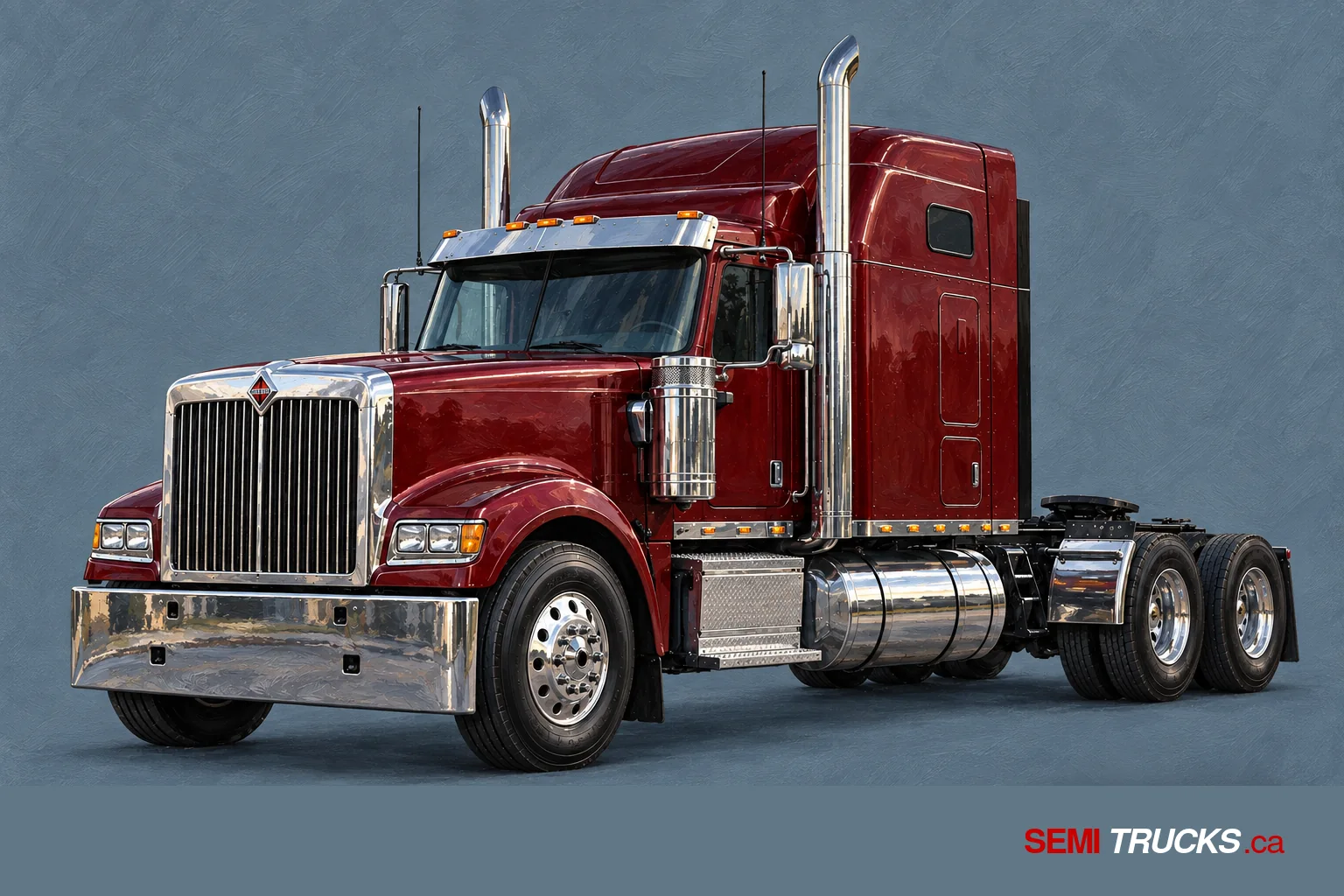
9900i-inspired artwork · illustrative, not configuration-specific
01 / FIND YOUR REFERENCE
Choose your reference.
Choose a model and dated publication, then explore its listed equipment options.
Catalogue reference
Options help you research a truck; only its build record confirms an ordered combination. Selecting equipment does not calculate dimensions or capacity.
About this edition & its evidence
April 2013 card. Published option ranges are not a VIN-specific build. This card prints 124 in BBC; the 2002 page prints 120 in. The difference is retained by source and is not a confirmed redesign boundary.
Select a measurement to highlight its endpoints and see what the chosen publication confirms.
9900i · 2013 · Navistar specification card · 3 published / 5 to verify
Side referenceCab, chassis & coupling9900i-inspired illustration · not to scale; not a model-specific build drawing.Front referenceExterior envelope9900i-inspired illustration · not to scale; not a model-specific build drawing.
Published value Needs verificationSchematic · not to scale
A / SIDE VIEW
Bumper to back of cab (BBC)
Front bumper to the back of the driving cab, excluding the sleeper. This is not the tractor’s overall length.
124 in3,150 mm
Published for this reference; confirm the individual build.
April 2013 card. Published option ranges are not a VIN-specific build. This card prints 124 in BBC; the 2002 page prints 120 in. The difference is retained by source and is not a confirmed redesign boundary.
9900i-inspired illustrative views · not a configuration-specific build drawing. Sleeper, exhaust, accessories and axle positions vary by build. The illustration does not establish transport clearance or trailer compatibility.
Request measured exterior and mirror widths, overall length, highest point and actual weight. Bunk width is an interior dimension and cannot establish transport fit.
03 / UNDER THE SKIN
Powertrain & chassis
Cummins ISX15. Published ranges cover available ratings; a truck’s engine plate, transmission model and axle tags identify its actual equipment.
The 9900 family URL covers the original identity and separately attributed i and ix editions. The April 2013 9900i card was rechecked September 9, 2026; archival 2002/2017 values remain tied to their existing references.
Reference boundaries and what to verify
Question
Documented reference
Buyer interpretation
2013 9900i geometry
124 in BBC; 30 in BA; 197–270 in wheelbase
3,150 mm; 762 mm; 5,004–6,858 mm. This family range does not map a sleeper to a wheelbase.
2013 engine and gearbox
Cummins ISX15; Eaton manual or UltraShift Plus
450–600 hp and 1,550–2,050 lb-ft are catalogue ranges, not the rating of every truck.
i versus ix
The retained 2002 references distinguish 120 and 130 in BBC
Do not resolve the 2013 124 in discrepancy by silently changing the early i value or declaring a redesign year.
Evidence to take to the inspection
For a 9900i candidate, photograph the VIN and certification label, engine dataplate, gearbox tag and sleeper identity before selecting a reference. Request dated records for replaced engines, wiring work, frame alterations and fifth-wheel installation. The 2013 card’s 52,000–60,000 lb GVW range cannot answer tractor-only scale weight. For transport planning, use a fresh uncoupled scale ticket and physical measurements of the installed truck.
Manufacturer evidence now reaches back to the original 1998 introduction. The later references are dated snapshots; they do not establish continuous generation ranges.
INTRODUCTION / 1998
The original Eagle 9900
Navistar’s 1998 annual report identifies the Eagle 9900 as a model introduced that year. This confirms a launch milestone; exact production boundaries and non-i dimensions still need separate evidence.
The archived i page lists a 120 in BBC; the ix lists 130 in. Both list four sleeper options. Eagle is a trim designation; the ix page specifies Eagle only.
A later factory card lists Cummins ISX15 power and Eaton manual or UltraShift Plus options. Its dimensional values belong to that card, including the BBC discrepancy flagged above.
The archived page changes the published power and wheelbase ranges and adds a GCW range. It also describes Premium and Eagle interiors. Trim does not establish hauling capacity.
What about the original 9900, day cabs and generation year ranges?
The original model’s 1998 introduction is now supported by Navistar’s annual report. A complete non-i specification, day-cab option matrix and production end dates remain to be verified. Send a dated factory brochure or VIN-linked build sheet to help close those gaps. A registration year, production date and engine emissions year can describe different things.
05 / PUTTING IT TO WORK
Match the trailer to the whole truck.
The period manufacturer pages identify highway, tanker and heavy-hauling applications. Suitability still depends on the individual build. Start with these HighwayTrailers.ca guides, then compare the complete combination.
Confirm the truck’s combination rating, axle and tyre limits, fifth-wheel vertical and drawbar ratings, kingpin compatibility, clearances, brakes and required connections. A component’s rating does not rate the complete truck.
GVW describes the loaded truck. GCW describes the loaded combination. Neither is a trailer payload allowance. Actual weights, component limits and the intended route still matter.
Moving the tractor as cargo
Record actual transport weight, exterior and mirror widths, overall length, highest point, wheelbase and ground clearance. Give those measurements to the carrier before choosing a deck.
Assess loading access, breakover, loaded height and securement with the carrier. A painted illustration or catalogue wheelbase cannot establish transport fit.
The selected reference does not establish a combination rating for a specific truck. Obtain the build-specific ratings and scale weights before calculating available load.
06 / FOLLOW THE EVIDENCE
Sources & open questions
Reviewed September 6, 2026. Manufacturer publications provide the dated specifications; metric values are conversions. Buying and trailer-matching notes are editorial guidance.
Next evidence needed: original 9900 technical literature; remaining production and model-year boundaries; exterior widths; cab-specific dimensions and weights; fifth-wheel configurations. Conflicting catalogue values remain attributed to their own edition.