Six cab references
Volvo’s current VNL family includes 300, 440, 640, 660, 840 and 860 configurations. Similar model numbers on older trucks do not establish the same equipment.
Volvo all-new VNL product reference · reviewed September 2026 ↗
THE TRACTOR REFERENCE DESK
Volvo's North American long-haul family.
01 / FIND YOUR REFERENCE
Start with the model configuration, then choose a publication and explore its documented equipment.
Selecting equipment records your research choice. It does not calculate dimensions, establish an available combination or rate a truck.
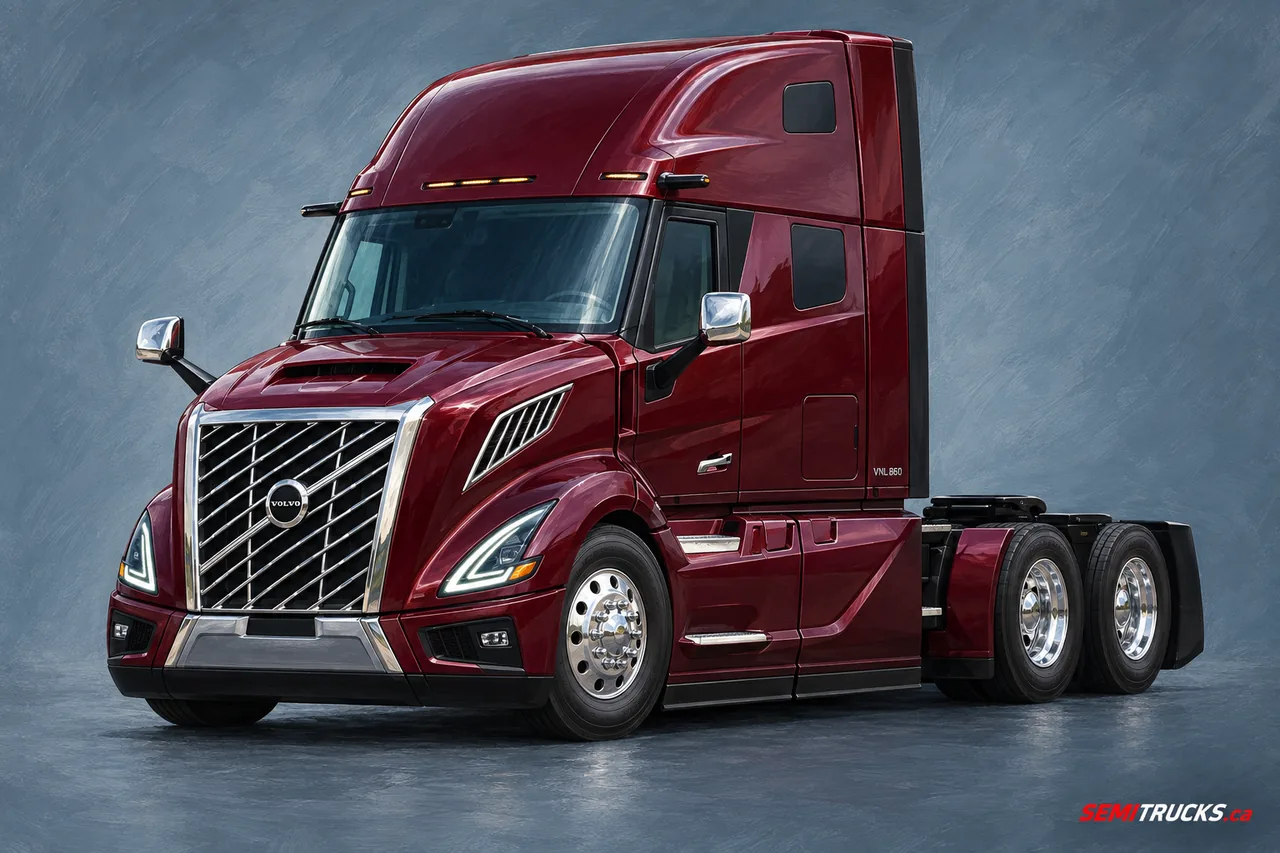
Volvo VNL 860 6×4 · Figure 25 and table · September 2025, pp. 65–66. One illustrated chassis, not the model-wide range. Original dimensions are millimetres. BBC includes the integral sleeper; the factory wheelbase runs to the first drive axle, not the tandem midpoint. Height and widths apply to the illustrated body and equipment.
Volvo VNL 860 6×4 · Figure 25 and table · September 2025, pp. 65–66 ↗
DIMENSION GUIDE / A–H
Select a measurement to highlight its endpoints and see what the chosen publication confirms.
Volvo VNL · VNL 860 · September 2025 · dimensioned 6×4 example · 7 published / 1 to verify
This Volvo drawing measures from the front bumper to the back of the integral sleeper. It is a different boundary from driving-cab-only BBC.
Published for this reference; confirm the individual build.
Original illustrative views; not to scale, a certified drawing or a selected-build rendering. Endpoints explain the measurements. Published values come from the cited reference, never from the image.
Selected reference: Volvo VNL 860 6×4 · Figure 25 and table · September 2025, pp. 65–66. Published values remain tied to this edition.
View the complete dimension table ↓02 / THE MEASUREMENTS
VNL 860 · September 2025 · dimensioned 6×4 example
| Measurement | Reference value | Scope / how to verify |
|---|---|---|
| Bumper to back of complete cab / sleeper | 218 in5,536 mm | Published in the selected manufacturer reference.Volvo VNL 860 6×4 · Figure 25 and table · September 2025, pp. 65–66 ↗ |
| Wheelbase | 192.9 in4,900 mm | Published in the selected manufacturer reference.Volvo VNL 860 6×4 · Figure 25 and table · September 2025, pp. 65–66 ↗ |
| Overall tractor length | 334.5 in8,497 mm | Illustrated chassis overall length; accessories may extend beyond it.Volvo VNL 860 6×4 · Figure 25 and table · September 2025, pp. 65–66 ↗ |
| Overall height | 160.4 in4,075 mm | Overall height of the illustrated configuration; verify actual roof equipment and ride height.Volvo VNL 860 6×4 · Figure 25 and table · September 2025, pp. 65–66 ↗ |
| Cab / body exterior width | 101.6 in2,580 mm | Both cab width W and width at rear of cab WROC are 2,580 mm in this example.Volvo VNL 860 6×4 · Figure 25 and table · September 2025, pp. 65–66 ↗ |
| Width across mirrors | 119.4 in3,034 mm | Across the mirrors shown in the factory example.Volvo VNL 860 6×4 · Figure 25 and table · September 2025, pp. 65–66 ↗ |
| Bumper to front axle (BA) | 52.2 in1,327 mm | Published in the selected manufacturer reference.Volvo VNL 860 6×4 · Figure 25 and table · September 2025, pp. 65–66 ↗ |
| Measurement | Reference value | Scope / how to verify |
|---|---|---|
| Fifth-wheel height | Not verified | Build record / measurement required. |
Measure fixed exterior width and mirror width separately, plus overall length, the highest accessory, fifth-wheel height and actual transport weight. Interior bunk width is not exterior width.
03 / UNDER THE SKIN
Engine installation not identified by this dimension table. VNL 860 6×4 · factory drawing example. Read engine, gearbox and axle ratings together.
Numerical powertrain ratings need a dated configuration-specific source. D13/I-Shift pairings, including Turbo Compound or I-Torque context, require exact generation and build evidence.
Read the installed unit’s identification plate and build record.
One illustrated chassis, not the model-wide range. Original dimensions are millimetres. BBC includes the integral sleeper; the factory wheelbase runs to the first drive axle, not the tandem midpoint. Height and widths apply to the illustrated body and equipment.
04 / MODELS, YEARS & CHANGES
Publication dates and launch milestones do not establish continuous model-year ranges. Match the VIN, production date and equipment era.
Volvo’s current VNL family includes 300, 440, 640, 660, 840 and 860 configurations. Similar model numbers on older trucks do not establish the same equipment.
Volvo all-new VNL product reference · reviewed September 2026 ↗The VN(4) manual supplies configuration-specific drawings. Wheelbase, cab boundaries and roof equipment must match the selected example before using its values.
Volvo VN(4) body-builder instructions · September 2025 · Section 0 ↗Review winter systems, corrosion, steering, aftertreatment, software history and sleeper equipment.
05 / PUTTING IT TO WORK
Six current cab configurations and earlier numerical cab designations must not be mixed.
Start with deck length, load placement, axle distribution and cab-to-trailer clearance.
Read the guide HIGHWAYTRAILERS.CACompare deck height, gooseneck geometry and the loaded combination’s height.
Read the guide HIGHWAYTRAILERS.CACheck neck compatibility, fifth-wheel loading, wet-kit requirements and the complete axle layout.
Read the guide HIGHWAYTRAILERS.CAReview the tractor, coupling, trailer, tyres and load as one combination.
Read the guideConfirm build-specific combination, axle, tyre and coupling ratings, kingpin and service connections, clearance and actual axle weights. GVW is the loaded truck; GCW is the loaded combination. Neither is trailer payload.
Give the carrier measured length, exterior and mirror widths, height, ground clearance and transport weight. Assess deck access, breakover, loaded height and securement together.
Deck height & loaded height ↗The model badge, artwork and catalogue option selectors cannot rate an individual combination. Obtain the actual build limits and scale weights.
06 / FOLLOW THE EVIDENCE
Reviewed September 7, 2026. Manufacturer figures remain tied to their stated reference; converted equivalents are rounded; original source units are retained. Application and inspection notes are editorial guidance.